




One of the most common questions we’re asked at Fleming Verandas is whether planning permission is required for a veranda, glass room or awning. The short answer is simple:
Planning decisions always rest with your local council.
There is no single national “yes or no” rule that applies in every case, and anyone claiming otherwise is oversimplifying a system that depends heavily on location, property status, and ownership structure. What we can do, however, is explain the key factors that determine whether permission is likely to be required — and how to check properly before proceeding.
The Starting Point: Local Authority Control
Planning permission is administered by your local planning authority (LPA), usually your district or city council. While there are national planning frameworks, interpretation and enforcement sit locally. This is why two identical installations can receive different outcomes in different areas.
As a general rule, many verandas, glass rooms and awnings may fall under permitted development, but that does not mean they automatically do.
Conservation Areas
If your property is located within a conservation area, additional restrictions almost always apply.
Conservation areas are designated to preserve architectural or historic character, and councils are typically more cautious about external alterations. Even relatively lightweight structures — such as glass verandas or awnings — may require planning consent, particularly if they are visible from a public highway.
You can usually check whether your property is in a conservation area by:
- Searching your local council’s planning portal
- Using their online interactive mapping tools
- Contacting the planning department directly
If your home is in a conservation area, it is strongly recommended that you seek written guidance from the council before commissioning any installation.
Listed Buildings
If your property is listed, planning permission — and often listed building consent — will almost certainly be required for a veranda, glass room or awning.
Listed status protects not just the main structure, but sometimes attached land and outbuildings as well. Even sympathetic, reversible additions can require approval, and carrying out works without consent can have serious legal consequences.
If your home is listed, always consult the council before proceeding. In many cases, professional drawings and supporting statements may be required as part of the application.
Shared Ownership, Leasehold & Flats
If you do not own the freehold outright, planning permission is only part of the picture.
For properties that are:
- Leasehold
- Shared ownership
- Part of a block of flats
- Managed developments
You will almost always need written permission from the freeholder, housing association, or management company, even if planning permission is not required.
Housing associations, in particular, typically recommend confirming consent in writing before works begin. Proceeding without approval can put you in breach of your lease, regardless of planning status.
Housing Associations & New-Build Estates
On newer housing developments, there may be restrictive covenants or estate rules that limit external alterations — even after the initial build period.
In these cases:
- Planning permission may not be required
- But developer or estate approval still may be
Again, written confirmation is key. Verbal assurances are rarely sufficient if issues arise later.
Awnings: Often Simpler, But Not Guaranteed
Retractable awnings are generally less likely to require planning permission than permanent structures, particularly if they do not project excessively or permanently alter the appearance of the property.
However, exceptions still apply — especially in conservation areas, on listed buildings, or where visibility and aesthetics are tightly controlled.
How to Find Out for Certain
The only definitive answer comes from your local council. We always recommend one of the following:
- Submitting a pre-application enquiry to your LPA
- Requesting written confirmation from the planning department
- Checking local planning guidance specific to your postcode
This ensures clarity before any commitment is made.
Our Approach at Fleming Verandas
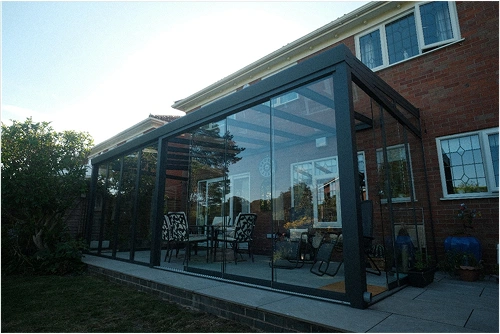
At Fleming Verandas, we design and install premium glass verandas, glass rooms and awnings with planning considerations firmly in mind. While we cannot override council decisions, we can:
- Advise on common planning sensitivities
- Help you understand whether your property raises red flags
- Design systems that are sympathetic to local context
Our aim is to ensure you move forward informed, compliant, and confident — not relying on assumptions or generic online advice.
Final Thought
If there is one takeaway, it is this: the local council is the final authority.
Every property is different, and planning rules are not one-size-fits-all. Taking the time to check properly at the outset can save significant time, cost, and stress later on.
If you’d like to discuss your property or explore suitable options, the Fleming Verandas team is always happy to help.

Got questions? Here are a few of our most frequently asked!
How do I contact my local council about planning permission?
Most councils have a planning or development control section on their website, usually with a general enquiries email address or online form. Searching “[your council name] planning department” will typically take you to the correct page.
What information will the council usually ask for?
Councils commonly ask for the property address, a brief description of the proposed structure, approximate dimensions, and where it will be located in relation to the house and boundaries. Some may request photos or a basic sketch.
Is a pre-application enquiry the same as a planning application?
No. A pre-application enquiry is an informal request for guidance and does not grant permission. It is often used to confirm whether a full application is required before progressing further.
How long does it take to get a response from the council?
Response times vary between councils. Informal enquiries may be answered within days, while pre-application advice can take several weeks depending on the authority and workload.
Can planning requirements change after installation?
Yes. Planning policies can evolve, and enforcement approaches may change over time. This is why obtaining written confirmation before installation is advisable.
Will planning permission (if required) delay installation?
Potentially. If permission is required, installation cannot proceed until approval is granted. Timelines depend on the council’s planning process and whether additional information is requested.
Should I keep planning correspondence for future reference?
Yes. Planning correspondence should be retained with your property records, as it may be relevant for future alterations or when selling the property.